Marco Polo

The diplomacy of travel

A 13th-century Venetian merchant, Marco Polo was one of the first great figures of modern exploration.

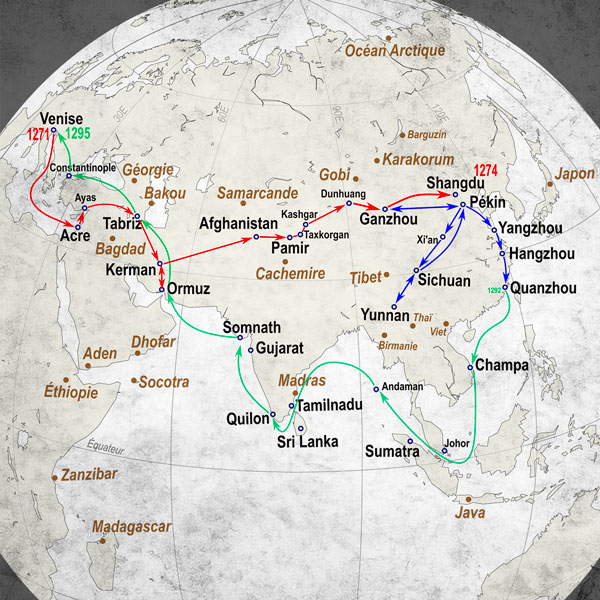
At just 17 years of age, he left Venice on a journey lasting more than 20 years through the East, ending up at the court of the Sino-Mongol emperor Kublai Khan (grandson of Genghis Khan).

From the Silk Road to the palaces of China, he discovered refined civilisations, precious skills and rare materials — silks, spices, porcelain — which he helped to introduce to the West.

By joining the administration of the Great Khan and becoming an imperial emissary, Marco Polo became one of the first diplomats and ambassadors of his time, at a period when there was no structured diplomatic corps.

Itinéraires de Marco Polo. En rouge, aller (1271-1294).– En bleu, missions en Chine (1275-1290). – En vert, retour (1292-1295). – En brun, lieux cités hors itinéraire certain. Carte orthographique des voyages de Marco Polo par Archibald Tuttle et Valp.
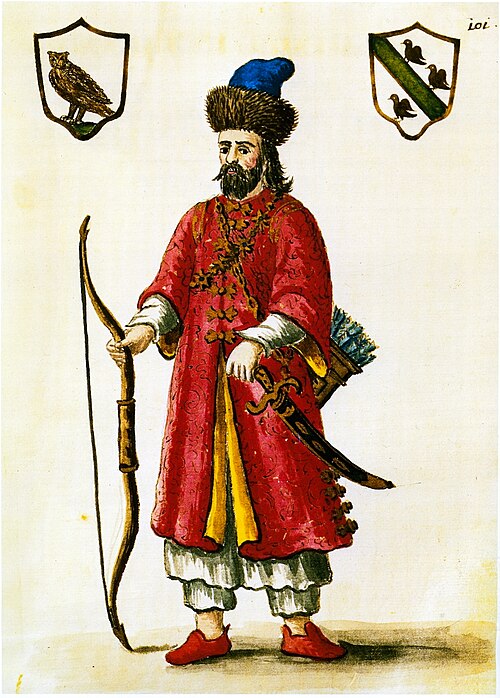
Marco Polo in Tartar costume, 18th-century illustration, Coureurs des mers, Poivre d'Arvor.

The trusted stranger

Having left Venice with his father and brother for trade purposes, Marco Polo was trained from an early age in caravan routes, the exchange of rare materials and the interpretation of territories — a culture of trade that would shape his future diplomacy and his entry into the service of the Sino-Mongol emperor Kublai Khan.

The latter, whose kingdom was vast and therefore multicultural, hired Marco Polo to be his eyes and ears. He sent him across many provinces of the Empire—from Sichuan to Yunnan, from Tibet to the borders of India—with missions that were already part of modern diplomacy: inspecting territories, observing local customs, assessing resources, understanding trade routes, reporting on the state of cities and populations, and transmitting messages from the central government.

For Kublai Khan, Marco Polo embodied a valuable link with the West, arriving as an indirect messenger from the Pope and Christian Europe. But if he trusted him, it was above all because he was a foreigner, and therefore:

  • free from rivalries, whereas local elites are often caught up in clan politics and family and regional loyalties
  • politically neutral, belonging to no Chinese or Mongol clan, with no local interests and therefore no threat to the established power
  • endowed with a fresh perspective, unfiltered by culture and without preconceptions about the territories

The Book of Wonders

Marco Polo entrusted the story of his life to Rustichello da Pisa, a Tuscan writer, giving rise to a work entitled The Description of the World.

Quickly copied and translated throughout Europe, this renowned account, renamed The Book of Marvels, opened a new window onto medieval Asia, fuelling the imaginations of travellers and cartographers for centuries and becoming a reference work for the great explorations to come.

Through it, Europe discovered, among other things, the existence of oil, asbestos, coal and paper money, as well as the organisation of Chinese cities, caravan routes, commercial practices and the customs of civilisations that were largely unknown until then.

“Lords, Emperors and Kings, Dukes and Marquises, Earls, Knights and Burghers, and all of you who wish to learn about the different races of men and the variety of the various regions of the world, and to be informed of their customs and traditions, take this book and read it; for therein you will find all the great wonders and diversities of Greater and Lesser Armenia, Persia, Turkey, Tartary, and India, and many other provinces of Middle Asia and part of Europe, when one travels towards the Greek Wind, the Levant, and the Tramontane; this is how our book will tell you about them in a clear and orderly manner, just as Sir Marco Polo, wise and noble citizen of Venice, describes them because he has seen them with his own eyes. No doubt there are some things here that he did not see, but he heard them from men worthy of belief and quotation. That is why we will present the things seen as seen and the things heard as heard, so that our book may be sincere and true, without any falsehood, and its words cannot be accused of being fables.

Inspiration

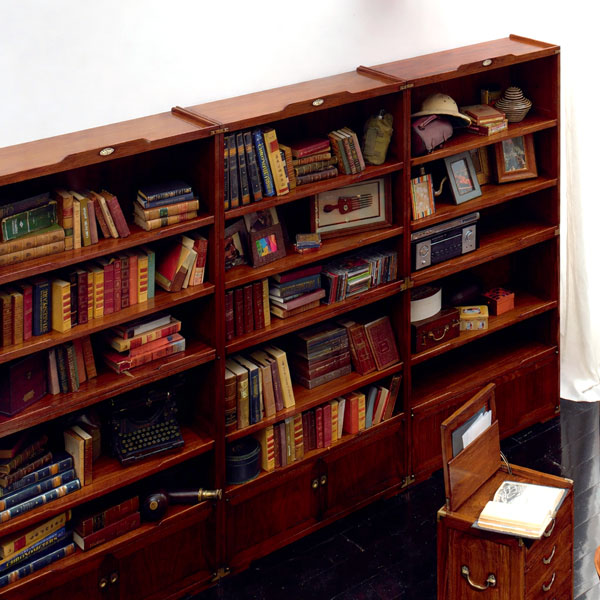
It is this extraordinary heritage that inspires us and encourages us to create exceptional furniture that tells stories both big and small. Our Marco Polo bookcase is a two-piece set, like travel furniture, easy to move and designed to house your precious books.

Three Marco Polo bookcases, by Starbay.

Whether you want to store The Book of Marvels or your own adventure stories, like those Marco Polo told Kublai Khan, this high-end storage unit has been designed to accompany you and bring the spirit of travel into your home.

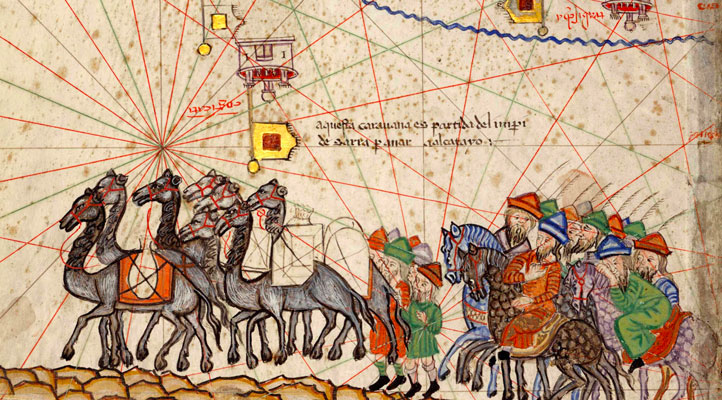
Marco Polo's caravan travelling to India. Miniature by Abraham Cresques in the Catalan Atlas.