Surcouf

THE TIGER OF THE SEAS

At the end of the 18th century, as France and Britain competed for control of the oceans and the great maritime trade routes, a young Breton sailor was about to become one of the most feared adversaries of British merchant shipping.

Robert Surcouf was born on 12 December 1773 in Saint-Malo, a maritime city whose prosperity had long been built on overseas trade and privateering expeditions. Born into a family of merchants and shipowners, and related to the famous privateer René Duguay-Trouin, he grew up in a world where tales of distant voyages and naval battles fuelled the ambitions of young sailors from Saint-Malo.

At just thirteen, he embarked on his first voyage, discovering the long sea routes to the Indian Ocean. His early training notably took place aboard ships involved in the slave trade, an activity in which he himself participated at the beginning of his career. When war broke out between Revolutionary France and Great Britain in 1793, maritime trade routes became battlegrounds.

Surcouf then turned to privateering. Unlike pirates, privateers operated with the authorisation of their government, attacking enemy vessels to disrupt their trade and seize their valuable cargoes.

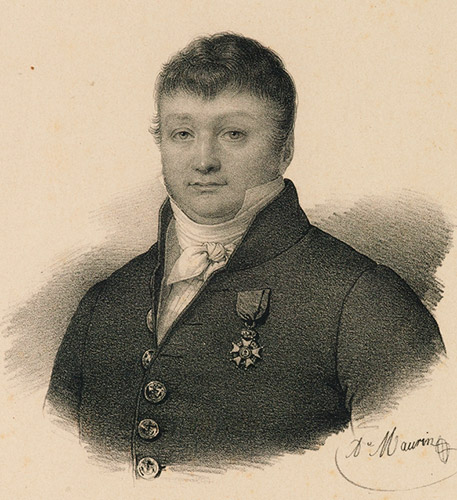
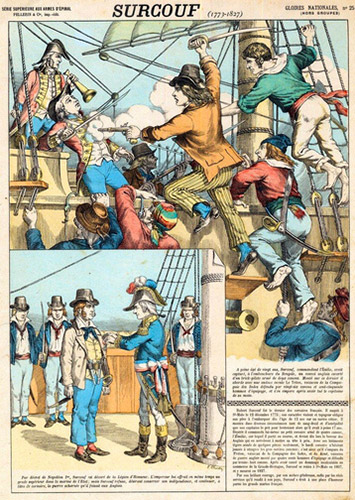
Lithograph of Robert Surcouf, by A. Maurin, 1835.

THE CAPTURE OF THE KENT

From the Isle de France, now known as Mauritius, a strategic French stronghold in the Indian Ocean, the young captain embarked on his first campaigns against British vessels. In 1796, he notably captured the Triton, an armed merchant ship belonging to the British East India Company, despite its superior firepower. His reputation began to spread throughout the ports of the Indian Ocean.

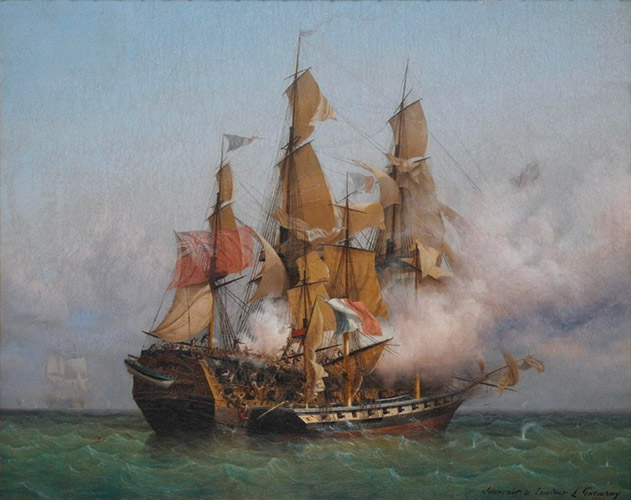
Capture of the Kent (40 guns and 437 men) by La Confiance (24 guns and 160 men), painting by Ambroise- Louis Garneray.

On 7 October 1800, in the Bay of Bengal, Robert Surcouf achieved the feat that would secure his place in maritime history.

Aboard La Confiance, a fast and manoeuvrable privateer vessel, he spotted the Kent, an imposing ship of the British East India Company carrying cargo and passengers.

Despite his opponent's superior size and firepower, Surcouf decided to attack. Taking advantage of his ship's speed and the element of surprise, he managed to approach the British vessel and ordered his men to board. The battle was brief but particularly fierce. In less than fifteen minutes, the French privateers seized control of the Kent, whose British captain was killed during the fighting.

News of this spectacular victory spread rapidly. By capturing a ship far larger than his own, Surcouf demonstrated that audacity and skilful seamanship could sometimes triumph over superior firepower. The episode became one of the most celebrated exploits in the history of French privateering, earning Surcouf the nickname "Tiger of the Seas".

FROM PRIVATEER TO SHIPOWNER

Returning to France in 1801, Robert Surcouf was now a wealthy and celebrated man.

His successes earned him official recognition. In 1804, Napoleon Bonaparte awarded him the Legion of Honour, while the wealth accumulated from his captures enabled him to expand his commercial activities in Saint-Malo. Yet the call of the open sea remained.

In 1807, Surcouf set sail once again aboard Le Revenant, a new privateer vessel with which he undertook one final campaign in the Indian Ocean, capturing numerous British merchant ships.

After his final return to France in 1809, he devoted himself primarily to his activities as a shipowner and merchant, becoming one of Saint-Malo's wealthiest maritime figures.

He died on 8 July 1827, at the age of 53, leaving behind a legend shaped by tales of daring boardings, distant voyages and Franco-British rivalries. Although his exploits as a privateer have long dominated his legacy, his career also reflects the darker realities of colonial maritime trade, particularly his involvement in the slave trade.

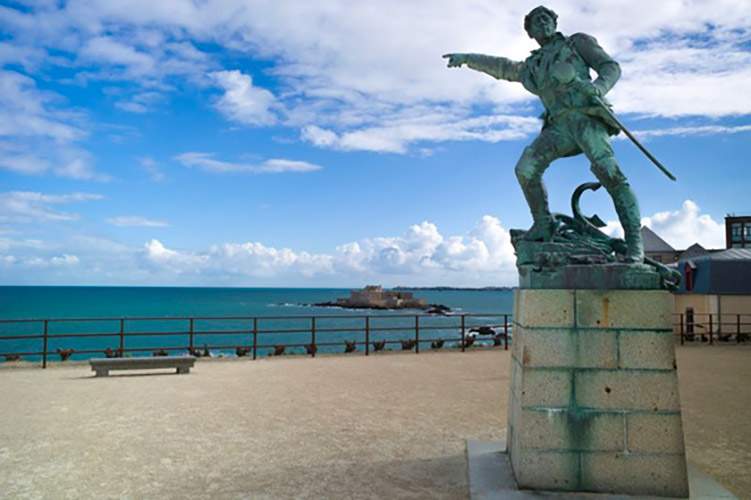
Statue honouring Robert Surcouf in Saint-Malo.

Inspiration

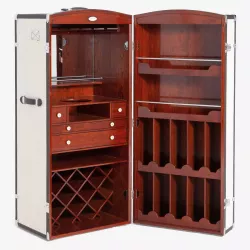
From Saint-Malo to the trading posts of the Indian Ocean, Robert Surcouf embodies an era when the oceans lay at the heart of rivalries between European powers, and fortunes were made through trading expeditions and the capture of enemy vessels. It is from this world of great sea voyages and distant adventures that Starbay draws inspiration for its Surcouf bar trunk. After all, what self-respecting privateer would ever have set sail without a few good bottles on board?

With its metal reinforcements, leather handles and cleverly designed interior, it evokes the travel trunks that once accompanied passengers aboard ships. Behind its doors lies a fully equipped bar, with dedicated space for bottles and glasses, recalling the elegance and refined lifestyle of the first-class cabins aboard the great ocean liners.

Robert Surcouf boarding the East India Company's ship Triton in 1796, engraving.

The perfect way to raise a glass to Saint-Malo's most famous privateer!